
The Cortisol Crash:
How Chronic Stress Is Silently Destroying Your Hormones
Training hard. Doing everything right. And still not recovering. Still gaining belly fat. Still waking up tired. This isn’t a willpower problem — it’s an HPA axis problem. Here’s the system, the signs, and the framework to fix it.
“I know what a broken HPA axis feels like from the inside. Not from a textbook — from February 2026, when cortisol carried me through two weeks of hell and then my system collapsed the moment the emergency was over. Training harder made it worse. Eating cleaner made it worse. The only thing that worked was understanding what was actually happening biologically.”
Cortisol Is Adaptive — Not Evil
Cortisol gets blamed for everything. Fat gain, muscle loss, low testosterone, mood crashes, poor sleep. The framing makes it sound like the enemy. It’s not. Cortisol is one of the most important hormones in your body — when it functions the way it’s designed to.
Cortisol is produced by the adrenal cortex in response to ACTH (adrenocorticotropic hormone) from the anterior pituitary. In acute situations, it mobilizes energy from stored glucose, sharpens focus, temporarily suppresses inflammation, and prepares the body for a physical threat. That response has kept humans alive for hundreds of thousands of years.
Healthy cortisol pulse
When cortisol works, it protects you.
Short-term cortisol is not the villain. It is the body’s rapid mobilization signal: wake up, fuel the system, sharpen attention, control inflammation, and survive the demand.
The problem isn’t cortisol. The problem is what happens when the acute stress response gets left on indefinitely — when your body can’t distinguish between a predator, a deadline, a brutal training session, four hours of sleep, and the weight of everything you’re carrying at once.
Chronic cortisol elevation reverses every one of its short-term benefits and turns them into long-term liabilities.
The HPA Axis Explained
The HPA axis is the stress-response system: Hypothalamus → Pituitary → Adrenal. Each stage amplifies and transmits the stress signal.
- Hypothalamus detects a stressor (physical, psychological, biochemical, inflammatory) and releases CRH (corticotropin-releasing hormone)
- Anterior pituitary receives CRH and releases ACTH (adrenocorticotropic hormone) into the bloodstream
- Adrenal cortex receives ACTH and produces cortisol
- Negative feedback — cortisol feeds back to both the hypothalamus and pituitary to dampen further CRH and ACTH release
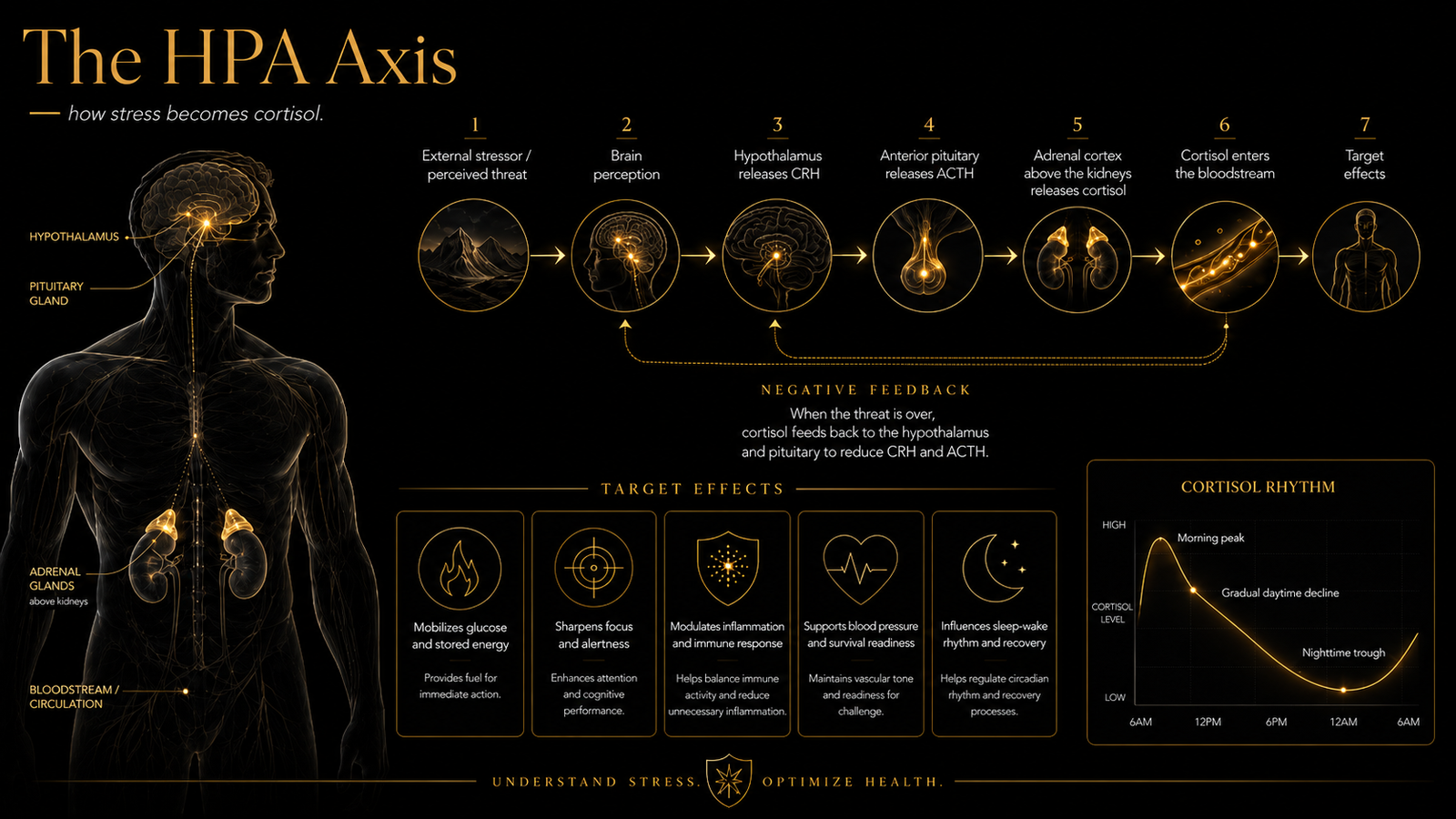
In a healthy, regulated HPA axis this feedback loop works precisely — cortisol spikes in the morning (cortisol awakening response), declines through the day, bottoms out at night to allow deep sleep and recovery. That’s the natural cortisol curve.
Under chronic stress the feedback loop breaks down. The hypothalamus keeps releasing CRH. The pituitary keeps signaling ACTH. The adrenals keep producing cortisol. Over time, the system dysregulates in one of three patterns: chronically elevated, flat with no morning peak, or suppressed below functional range. Each requires a different intervention. None of them is solved by “just relaxing.”
Pattern recognition
The same stress load can create three different cortisol pictures.
This is why guessing fails. The man who is wired at night, the man who cannot wake up, and the man who feels completely empty may all have an HPA axis problem – but not the same HPA axis problem.
Pattern 01
Elevated: stuck in threat mode
Wired but tired, light sleep, night waking, irritability, belly fat, caffeine dependence, low patience, and a body that never feels safe enough to recover.
Testosterone suppression, insulin resistance, gut permeability, thyroid drag, immune suppression, and poor deep sleep.
Pattern 02
Flat: no morning peak
No drive on waking, afternoon crash, flat mood, poor word recall, training feels heavier than it should, and stimulation becomes the only way to function.
Circadian dysfunction, low resilience, poor training adaptation, reduced motivation, unstable blood sugar, and chronic under-recovery.
Pattern 03
Suppressed: below functional output
Deep exhaustion, low stress tolerance, heavy limbs, poor recovery, dizziness or shakiness under load, emotional fragility, and a sense that the system has gone offline.
Severe burnout physiology, inflammatory vulnerability, poor immune response, low blood pressure patterns, and the need for proper clinical screening when symptoms are intense.
Signs of HPA Axis Dysregulation
These are the patterns I see consistently in men with disrupted cortisol dynamics. They often dismiss them as “just stress” or “getting older.” They’re neither. They’re symptoms of a specific biological dysfunction with a specific biological cause.
- Wired but tired — exhausted but can’t switch off or fall asleep
- No morning drive or motivation, even after what should have been adequate sleep
- Visceral fat accumulating around the abdomen and lower back despite training and controlled eating
- Afternoon energy crash, often between 2–4pm
- Recovery from training sessions taking significantly longer than before
- Irritability, low patience, or emotional flatness that’s out of character
- Low libido, reduced drive, and diminished competitive edge
- Relying on caffeine to function in the morning and alcohol or cannabis to wind down at night
- Getting sick more often, or taking longer to recover when you do
- Brain fog, poor word recall, and slower decision-making
The more of these that overlap, the more likely the HPA axis is the primary driver — not the symptom list on the surface.
The Downstream Destruction: What Chronic Cortisol Actually Does
Testosterone Suppression
This is the most direct and most overlooked connection. The HPA axis (stress) and the HPG axis (testosterone production) share upstream signaling. Chronic cortisol elevation suppresses GnRH (gonadotropin-releasing hormone) from the hypothalamus. GnRH drives LH and FSH from the pituitary, which drive testosterone from the testes. Suppress GnRH and the entire downstream cascade drops. This is called HPA-HPG cross-talk. Many men diagnosed with “low testosterone” actually have HPA axis dysfunction as the primary driver. TRT doesn’t fix that. Addressing the actual stress load does.
Gut Permeability
CRH (the first signal in the HPA cascade) directly increases intestinal permeability through mast cell activation in the gut lining. Chronic psychological stress loosens the tight junctions of the intestinal epithelium — literally making the gut wall leaky. LPS (lipopolysaccharide, from gram-negative gut bacteria) translocates into the bloodstream. The systemic inflammatory response amplifies cortisol further. It’s a feed-forward loop: stress increases gut permeability, gut permeability increases inflammation, inflammation elevates cortisol.
Thyroid Suppression
Chronic cortisol inhibits 5′-deiodinase, the enzyme that converts inactive T4 to active T3. It also increases conversion to reverse T3 (rT3) — a metabolically inactive form that competes with T3 at receptor sites. The result is effectively a hypothyroid state with normal TSH. This is why many men with chronic stress present with every symptom of hypothyroidism — cold, slow metabolism, low energy, hair thinning, constipation — while their standard thyroid panel looks “normal.”
Insulin Resistance
Cortisol upregulates hepatic gluconeogenesis (the liver manufacturing glucose from non-sugar sources) and inhibits GLUT-4 translocation in muscle tissue. The result is elevated fasting blood glucose, impaired glucose clearance, and progressive insulin resistance — even in men who train consistently and eat reasonably well. Visceral fat accumulation is both a consequence and a driver of this cycle.
Immune Dysregulation
Short-term cortisol is immunosuppressive — it down-regulates inflammatory response as part of the survival mechanism. Chronically elevated cortisol initially suppresses immune function (more frequent illness, slower healing), then, as the system compensates, drives upregulation of inflammatory cytokines including IL-6, TNF-α, and IL-1β. The immune system becomes simultaneously under-reactive to pathogens and over-reactive to its own tissue.
Sleep Architecture Disruption
Deep sleep (slow-wave sleep, stages 3 and 4) is when growth hormone is secreted, cellular repair occurs, cortisol is cleared, and the HPA axis resets. Elevated evening cortisol blocks the transition into deep sleep. Less deep sleep means less GH secretion, less tissue repair, less cortisol clearance — and more cortisol the following day. The cycle compounds over weeks and months into what feels like a body that simply doesn’t recover anymore.
▲ Free Health Screening
Do you recognise yourself in this picture?
PrimalScan maps your HPA axis load, cortisol pattern indicators, hormonal downstream effects, gut function, and sleep architecture across 12 systems. Identifies your primary bottleneck. Personal recorded analysis from me within 48 hours. Free.
Map My Stress System With PrimalScan →My Dark Season: What This Looks Like From the Inside
In February 2026 my wife Alisha nearly died from leptospirosis-induced meningitis. She spent two weeks in critical condition. The hardest part was not only the illness itself. It was the moment I had to stand between the standard hospital pathway, my wife’s agony, and what I knew from instinct, pattern recognition, and years of health work was happening inside her body.
She was in 9/10 pain, unable to open her eyes, begging me for relief. The hospital wanted to wait for lab confirmation before treating the picture I was already certain was leptospirosis, and the pain-relief path being pushed felt dangerous in the context I was looking at: platelets, bleeding risk, organ stress, and a system already on the edge. I was being told I was wrong. My wife was begging me to make it stop. Every part of me wanted to give her immediate relief. Instead I had to stand there, take the pressure, and refuse the move I believed could make the situation catastrophic.
I checked her out of the hospital and brought her home. For the next two weeks I was running a business, managing our child, caring for Alisha, tracking symptoms, deciding the treatment direction, organising medication, supplements, and peptide support, and carrying the full weight of decisions I could not outsource. There was no one I could lean on in the way I needed. I did not sleep. I was too afraid to sleep. Too much was resting on my shoulders.
That is the part of cortisol people miss. In that window, cortisol was not the enemy. Cortisol helped me focus. Cortisol kept me from breaking down. Cortisol gave me access to energy I did not have. It helped me stay sharp enough to make decisions while the world around me felt like it was closing in. Acute cortisol can be heroic. It can carry a man through hell.
But the body always collects the invoice. The moment Alisha was stable enough to help with the household again, my system collapsed. It was not a soft crash. It was a complete emotional breakdown. The fear of losing her, the responsibility, the zero sleep, and the two weeks of sky-high cortisol all came back through my nervous system at once. I could not string a sentence together. I could not answer basic questions. “Steak or eggs for breakfast?” felt too complex. My brain had gone offline.
In the weeks after, I was functionally broken. Training that previously felt easy felt impossible. Recovery had stopped. My cognition was blunted. My gut was dysregulated. My motivation, usually something I’ve never questioned, had flatlined. And my bloodwork showed exactly what was happening: HPA axis load written into every marker that responds to it.
I know what I’m describing here because I lived it. Not as a clinical case study, but as a man who believed he could outwork his biology and discovered he was wrong. The HPA axis does not negotiate. It does not respond to pride, pressure, or willpower. It responds to real inputs: sleep, load, safety signals, nourishment, light, time, and the honest removal of what the body can no longer carry.
What I did, and what I’d recommend, was not more discipline. It was a systematic reduction of total load, a structured reset framework, and targeted clinical support for the systems that had fallen furthest behind. The lesson was brutal but clean: cortisol saves you in the acute emergency, but if you keep living as if the emergency never ended, the same system that protected you becomes the system that breaks you.
The HPA Reset Framework
There’s no single supplement or protocol that fixes chronic HPA dysregulation. The reset is multi-system. These are the levers that matter most, in approximate order of impact:
Sleep Architecture First
Nothing else works if sleep is broken. Anchor sleep to a consistent time (10pm or earlier). Eliminate blue light exposure 90 minutes before bed — blue light suppresses melatonin and maintains cortisol elevation. Temperature below 20°C (68°F) in the sleeping environment. Magnesium glycinate (300–400mg), L-theanine (200mg), and adequate zinc are the nutritional foundations. If cortisol is severely dysregulated, do not use stimulant pre-workouts before evening training sessions.
Training Load Reduction — Not Elimination
Training is a cortisol stressor. During HPA burnout, high-intensity training adds to the load that’s already breaking the system. The counterintuitive move: reduce volume and intensity temporarily. Prioritize walking and Zone 2 cardio (conversational pace, approximately 60–65% max heart rate). These improve HRV, reduce inflammatory load, and maintain movement without adding adrenal demand. HIIT and high-intensity lifting can return once HRV is trending upward and sleep quality improves.
Meal Timing
Cortisol naturally peaks in the morning as part of the cortisol awakening response. Fasting in the morning amplifies this peak further. For men with active HPA dysregulation, training fasted and skipping breakfast is a direct cortisol spike amplification protocol — doing the opposite of what the system needs. Eat within 60 minutes of waking. Prioritize protein and complex carbohydrates in the morning. Save intermittent fasting for when the system is regulated.
Nervous System Downshift
The physiological sigh (double inhale through the nose, long exhale through the mouth) is the most rapid nervous system downshift available — it deflates alveoli and triggers a parasympathetic shift within seconds. Daily HRV monitoring (morning, before any input) gives objective data on nervous system recovery trajectory. Cold/heat cycling through sauna and cold immersion — when the system is not in acute burnout — supports HPA recalibration. Breathwork protocols (4-7-8, box breathing) practiced daily build consistent parasympathetic tone.
Circadian Anchoring
Morning light exposure within 30 minutes of waking is one of the most underutilized interventions in this context. Natural light in the AM sets the circadian clock, anchors the cortisol awakening response to an appropriate window, and improves evening melatonin secretion. The effect is dose-dependent — 10 minutes outside in natural light outperforms any supplement combination for circadian reset. This is free, requires zero technology, and most men skip it entirely.
▲ Clinical Peptide Support for the Nervous System
Educational overview only. These peptides may support stress response, sleep architecture, and nervous system regulation under appropriate clinical guidance. Not a substitute for the foundational interventions above. Clinical consideration requires personal health screening.
Selank
A synthetic heptapeptide analog of tuftsin with anxiolytic properties mediated through GABA-A receptor modulation and enkephalin stabilization. Selank reduces anxiety without sedation — a key distinction from pharmaceutical anxiolytics. Also modulates IL-6 and other inflammatory markers, and may stabilize emotional and mood dysregulation associated with chronic HPA activation. Used in Russia clinically for anxiety, asthenic conditions, and cognitive support under psychological stress.
DSIP (Delta Sleep-Inducing Peptide)
A nonapeptide with documented sleep-promoting effects, particularly for slow-wave (deep) sleep restoration. DSIP may reduce cortisol secretion and normalize circadian cortisol patterns. Also has antioxidant and stress-limiting effects in the central nervous system. Most relevant in the context of HPA dysregulation where deep sleep architecture is severely disrupted and conventional interventions alone aren’t sufficient to restore it.
BPC-157
Relevant here for its gut-protective effects under HPA axis load. Chronic cortisol directly increases gut permeability — BPC-157 counteracts this through mucosal repair, tight junction support, and anti-inflammatory mechanisms in the GI tract. Also has vagal nerve modulating properties that may support parasympathetic tone. In the context of cortisol-driven gut dysfunction and nervous system dysregulation, BPC-157 addresses the downstream gut damage while the upstream HPA interventions take hold.
CJC-1295 + Ipamorelin
Relevant when chronic stress has suppressed deep recovery, GH pulsatility, tissue repair, and training adaptation. CJC-1295 and Ipamorelin are commonly considered together because they support growth hormone signaling through complementary pathways. This is not a shortcut around sleep, food, and nervous system regulation. It is a clinical layer to consider when the recovery system has fallen behind and the foundations are already being rebuilt.
▲ Clinical Pathway — Free Consultation
Is clinical support appropriate for your situation?
If your stress load is high, your recovery is broken, and lifestyle optimization alone isn’t moving the needle — Eternal Wellness Center can assess your case properly. Peter reviews your full health screening personally. Protocols are designed from your biology, not a template. Free consultation. No obligation.
Book Free Consultation → Free · No obligation · Reviewed personally by PeterPractical Action Steps — Start Here
If you’re reading this and recognising more than three items in the dysregulation list, this is what I’d prioritize first — in order:
- Get morning light within 30 minutes of waking. Minimum 10 minutes outside. Non-negotiable for circadian reset.
- Anchor your sleep time. Same time every night. 10pm or earlier. Cold room.
- Eat breakfast within 60 minutes of waking. Stop fasting in the morning if your cortisol is dysregulated.
- Reduce training intensity temporarily. Replace one or two hard sessions per week with long walks or Zone 2 for 4–6 weeks and track HRV.
- Eliminate the evening caffeine and reduce alcohol. Both maintain evening cortisol elevation and block deep sleep.
- Add magnesium glycinate (300–400mg), zinc (30mg), and L-theanine (200mg) before bed. Basic but genuinely effective nutritional foundations for HPA recovery.
- Get a cortisol assessment. Ideally a 4-point salivary cortisol test to map the actual daily curve — not just a morning serum reading, which tells you very little about pattern.
If you’ve done all of this consistently for 8–12 weeks and the pattern hasn’t shifted, something else is driving it. That’s the point at which a proper clinical screening through PrimalScan or Eternal Wellness becomes the next layer.
The Bottom Line
The cortisol crash isn’t a character flaw. It isn’t aging. It isn’t weakness. It’s a biological system responding exactly the way it’s designed to respond — to an input load that exceeds its capacity to adapt. The response is appropriate. The load is the problem.
Your body isn’t broken. It’s responding exactly as it should. That means it can be recalibrated — with the right inputs, in the right order, with enough honesty about what the actual load is. Strip it back. Root cause. Always.
Koen Castelein
Founder, PrimalFitDad · Holistic Nutrition & Peptide Specialist
Men’s health coach at the intersection of biochemistry, functional nutrition, peptide therapy, epigenetics, and nervous system recalibration. Based in Bali. This article draws directly from lived experience through burnout in 2024–2025 and full recovery through systematic biological intervention.
Related Articles