
Aging Is Optional:
The Peptide Protocols That Changed My Biology
After 15+ years of peptide and coaching experience — four of them through underground sources I wouldn’t touch today — this is what I actually know about peptides for anti-aging, performance, tissue repair, and longevity. And why pharmaceutical-grade changes the entire equation.
“My bloodwork at 32 surpasses what most men see at 22. That didn’t happen by accident and it didn’t happen by guessing from forum posts. It happened because I treated my biology like a system that responds to precise signals — not a machine you push until it breaks.”
Why We Actually Age
Aging isn’t passive decay. It’s an accumulation of biological maintenance failures that occur when damage outpaces repair. The scientific community now describes this through the hallmarks of aging — and once you understand them, targeted peptide protocols make a different kind of sense.
- Telomere attrition — the protective caps on your DNA shorten with each cell division. Short telomeres trigger cellular senescence or programmed cell death.
- Cellular senescence — dysfunctional cells that stop dividing but won’t die. They accumulate and secrete inflammatory signals (SASP — senescence-associated secretory phenotype) that degrade surrounding tissue.
- Mitochondrial dysfunction — less ATP produced per cell, more reactive oxygen species generated, progressive decline across every energy-dependent system in your body.
- Epigenetic drift — gene expression patterns shift with age. Repair and regeneration genes get silenced. Inflammatory genes get upregulated.
- Loss of proteostasis — protein quality control degrades. Misfolded proteins accumulate. Autophagy and proteasome function slow.
- Inflammaging — chronic low-grade systemic inflammation driven by senescent cells, gut dysbiosis, and cumulative cellular damage. The common thread in almost every age-related condition.
Certain peptides signal these maintenance systems to stay functional longer. They work at the level of gene expression, receptor activation, and cellular communication. That’s not marketing — that’s the verified mechanism for several compounds with decades of research behind them.
What Peptides Actually Are
A peptide is a short chain of amino acids — typically 2 to 50 residues — that functions as a biological signaling molecule. Smaller than proteins, but not the same as free amino acids. The distinction matters because specific amino acid sequences bind specific receptors and trigger specific cellular responses.
BPC-157 is not collagen in a vial. Epithalon is not telomerase in a syringe. Each peptide has a defined receptor profile, mechanism of action, and research body — imperfect and often preclinical, but present and growing.
Peptides are naturally produced throughout your body. Growth hormone-releasing hormone is a peptide. Insulin is a peptide. GnRH is a peptide. The pharmaceutical peptides used in therapeutic protocols are either identical to endogenous sequences or synthetic analogs engineered to extend half-life, improve receptor affinity, or reduce enzymatic degradation.
Peptide Signal Map
A peptide is a message. The receptor is the lock. The outcome depends on the system receiving it.
This is why peptides are not one universal category. A change in sequence, receptor affinity, half-life, tissue target, or timing can completely change the biological conversation.
They do not work by simply forcing androgen or estrogen receptors. Most peptides communicate through separate signalling pathways.
The best protocols support a system’s own biology instead of turning it off and overriding it.
The right peptide depends on the bottleneck: tissue, GH axis, inflammation, metabolic signalling, cognition, hormones, or longevity.
“This isn’t biohacker culture. It’s precision signaling. You’re giving your biology the same language it already speaks — just louder, and at the right time.”
What peptides are not: they are not steroids. They don’t bind androgen or estrogen receptors (with exceptions designed specifically for that purpose). They don’t replace your body’s systems — they interact with them. That difference matters both clinically and legally.
Why Pharmaceutical-Grade Matters — And Why I Wish I’d Known Sooner
I spent four years sourcing peptides through research chemical suppliers. I’m being direct about that because most people in this space have done the same or are considering it. The results weren’t nothing — but they were inconsistent, unpredictable, and in retrospect, a gamble I wouldn’t take again.
What the pharmaceutical-grade difference actually means:
- Purity verification — pharmaceutical compounding labs use HPLC and mass spectrometry to confirm peptide sequence and purity. Research-grade suppliers frequently ship at 80–85% purity with no documentation. The impurities aren’t benign.
- Accurate dosing — gravimetric verification ensures the vial contains what the label states. Underground vials can be 30–40% off-dose in either direction.
- Sterility and endotoxin testing — pharmaceutical compounders test for bacterial endotoxins. Non-sterile peptides delivered subcutaneously are a direct infection and inflammatory risk.
- Chain of custody — you know where it was made, by whom, under what conditions, with what materials.
- Proper reconstitution vehicle — bacteriostatic water, correct pH buffering, documented stability. Research peptides often ship with no guidance and inadequate vehicles.
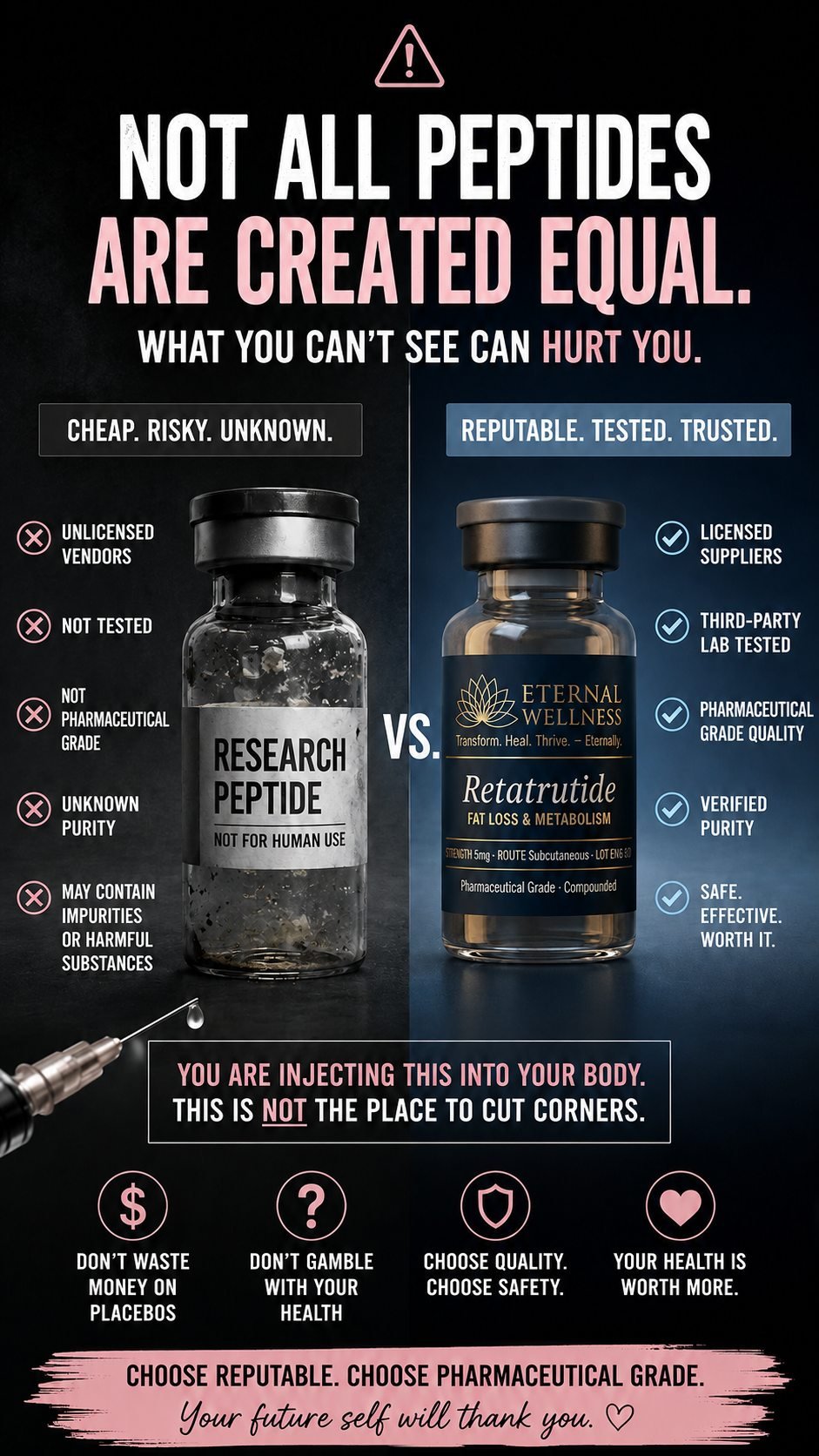
Moving to pharmaceutical-grade compounds through Eternal Wellness Center was the point where my protocols became reliable. Bloodwork correlation got cleaner. Outcomes became predictable. You cannot optimize a system if you can’t trust the inputs.
▲ Free Health Screening
Not sure if your biology is ready for peptide support?
PrimalScan maps your hormonal health, gut function, stress response, mitochondrial load, and liver detox across 12 systems. Identifies your primary bottleneck. Personal recorded review from me within 48 hours. Free.
Get My Free PrimalScan →The Five Protocol Pathways Worth Understanding
The mistake is thinking peptides are a menu of compounds. They are not. The right protocol starts by identifying the system that needs support, the signal that is missing, the outcome that matters, and the clinical guardrails that keep the process safe.
Most men do not arrive with a peptide problem. They arrive with a pattern: performance has plateaued, fat loss has become resistant, recovery has stalled, hormones feel off, or aging is showing up faster than their habits should allow. The protocol pathway helps map that pattern to the right clinical conversation.
Eternal Wellness Protocol Map
Start with the problem pattern. Then choose the protocol family.
These pathways can stand alone or overlap. Peter designs the actual protocol from your health screening, bloodwork where relevant, contraindications, goals, and the biological system that needs the signal.
Physique & Performance
For men training hard but no longer adapting: stalled body composition, slower recovery, poor sleep restoration, strength plateau, or output that no longer matches effort.
View Physique & Performance →Fat Loss & Body Recomposition
For metabolic resistance: stubborn visceral fat, appetite dysregulation, insulin sensitivity issues, loss of lean mass during dieting, or fat loss that refuses to match discipline.
View Fat Loss & Recomp →Longevity & Cellular Health
For men who feel older than their habits should allow: cognitive drift, collagen decline, skin and hair aging, weaker immune resilience, lower vitality, and cellular repair debt.
View Longevity & Cellular Health →Healing & Recovery
For injuries, gut issues, chronic inflammation, post-surgical recovery, tendon and ligament problems, nerve irritation, or a body that never fully bounces back.
View Healing & Recovery →Hormone Optimisation
For low energy, low drive, libido decline, brain fog, sleep disruption, thyroid and metabolic symptoms, GH-axis suppression, or bloodwork that is “normal” while life feels anything but.
View Hormone Optimisation →▲ Peptides Worth Understanding
Educational overview only. Clinical consideration requires personal health screening and specialist review. All protocols at Eternal Wellness Center are designed individually from your health screening and bloodwork.
Epithalon (AEDG)
A tetrapeptide (Ala-Glu-Asp-Gly) with over 40 years of research originating from the St. Petersburg Institute of Bioregulation. Epithalon activates telomerase — the enzyme responsible for maintaining telomere length — addressing one of the primary biological clocks of cellular aging. Also regulates pineal gland function and melatonin synthesis. Used in periodic longevity cycles rather than continuous protocols.
GHK-Cu (Copper Tripeptide)
One of the most versatile peptides in a longevity stack. GHK-Cu upregulates over 80 genes involved in collagen synthesis, tissue repair, anti-inflammatory signaling, and DNA repair. Plasma levels decline from approximately 200 ng/mL at age 20 to under 80 ng/mL by age 60. Systemic GHK-Cu supports connective tissue integrity, vascular health, antioxidant enzyme upregulation, and neural health. A foundational longevity peptide with an excellent safety profile.
BPC-157 (Body Protection Compound)
A 15-amino-acid sequence derived from gastric juice protein. Among the most studied healing peptides in the class — accelerates repair across gut mucosa, tendons, ligaments, muscle, and bone through growth factor receptor upregulation (VEGF, EGF) and angiogenesis promotion. I’ve used this through bilateral bicep tears. The difference in tissue repair rate versus previous injuries without it was clinically noticeable at every bloodwork marker that tracked it.
Semax
An ACTH 4-10 analog developed for stroke and cognitive injury rehabilitation. Semax upregulates BDNF (brain-derived neurotrophic factor), enhances dopaminergic and serotonergic transmission, and improves cognitive performance under psychological and oxidative stress. In a performance context: sharper focus, accelerated decision-making, faster mental recovery from high-demand periods. Not a stimulant — a neurotrophin amplifier.
▲ Clinical Pathway — Free Consultation
Ready for pharmaceutical-grade peptide support?
Eternal Wellness Center designs every protocol from your personal health screening — not a template. Peter, their peptide and hormone specialist, personally reviews every submission before any compound is considered. Pharmaceutical-grade compounding. Nutrition and lifestyle alignment. Delivered worldwide.
Book Free Consultation → Free · No obligation · Reviewed personally by PeterMy 15+ Year Journey: What I Learned the Hard Way
I started peptides because my body was accumulating a debt faster than training and nutrition alone could service it. Over a decade of high-volume bodybuilding had left a trail through connective tissue, inflammatory load, and hormonal patterns that needed more than progressive overload to fix.
The first four years, I sourced through research chemical suppliers. The results were real enough to keep me interested but inconsistent. A BPC-157 protocol would visibly accelerate an injury one cycle — the next cycle, nothing. I understand why now: purity variance, dosing inconsistency, degraded compounds from poor storage and handling.
Shifting to pharmaceutical-grade through Eternal Wellness Center changed the trajectory. Protocols became predictable. Bloodwork became the anchor — not forum consensus. Cycling decisions were based on what my markers showed, not on what someone in a Discord server was running. My bloodwork at 32 now reads better than the averages I see in men much younger than me.
The deeper shift was conceptual. I stopped thinking about peptides as performance hacks and started thinking about them as biological conversations — precise language that cells already speak. The question changed from “which peptide is best” to “what signal does this system actually need right now, based on these specific markers?” That question requires bloodwork. And bloodwork requires a clinical relationship — not as bureaucracy, but as the mechanism that turns experiments into outcomes.
Who Might Be a Candidate for Peptide Protocols
Peptides are not appropriate for everyone and not necessary for most people at the foundational level. Sleep, stress, gut function, liver health, micronutrient sufficiency, and hormonal optimization through lifestyle must come first. With those genuinely in order, peptide protocols become relevant for men who:
Candidate Pattern Map
If two or more of these patterns are familiar, your issue may be biological signal loss — not discipline.
This does not diagnose you. It shows the common patterns where a clinical peptide review may be worth considering once foundations are already being handled seriously.
Training is consistent, nutrition is decent, but muscle, strength, recovery, and body composition no longer move proportionally.
Calories, cardio, and clean eating are not creating the expected result because appetite, insulin, hormones, or inflammation are pushing back.
Old injuries, gut irritation, joint pain, tendon issues, or post-surgical recovery remain active long after they should have resolved.
You feel less driven, less sexual, less sharp, and less resilient even when standard labs are dismissed as “normal.”
Skin, collagen, cognition, sleep quality, immune resilience, and vitality are declining faster than your habits suggest they should.
You are not waiting for disease. You want objective biomarkers, supervised cycles, and a proactive strategy for staying harder to break.
- Have chronic or recurring soft tissue injuries that aren’t resolving through standard rehabilitation
- Have reached a genuine ceiling on body composition despite optimized training and nutrition — and have bloodwork to confirm why
- Are experiencing measurable cognitive decline or chronic brain fog not explained by sleep or stress alone
- Are over 35 with bloodwork showing GH axis suppression, elevated inflammatory markers, or cellular aging patterns
- Have a specific longevity objective and want a protocol built from actual biomarkers rather than an off-the-shelf stack
- Are post-surgical or managing chronic inflammation that isn’t resolving through conventional approaches
Peptides are tools for precise optimization and targeted intervention. They are not a shortcut through the foundational work. If the foundations are broken, a peptide protocol builds on a broken base.
What an Eternal Wellness Consultation Actually Looks Like
One reason people hesitate on clinical support is they don’t know what it actually involves. Eternal Wellness Center is not built around handing you a product and a PDF. Their process starts with a free consultation form that captures your goals, health history, current medications and supplements, symptom picture, training context, and bloodwork if available.
Peter — their hormone and peptide specialist — reviews the submission personally and produces a clear health report before anything is recommended. If bloodwork is needed, they guide you through what matters. If peptide therapy is not appropriate, that should be identified before you spend money on a protocol.
Process Snapshot
A protocol should be built around biology, not copied from a menu.
Tom coordinates intake. Peter reviews the form personally and gives clarity on fit, risks, and next steps.
Bloodwork, history, goals, contraindications, and symptom context shape the clinical decision.
Peter designs the compounds. Trevor aligns nutrition and lifestyle so the body can execute the signal.
Tom stays with you through the cycle, Peter and Trevor adjust when needed, and the next phase is reviewed.
This is the model that should be the standard for anyone considering peptide therapy. A genuine clinical eye on your case. Pharmaceutical-grade compounds. Nutrition and lifestyle alignment. Ongoing accountability. Not a product sale dressed up as healthcare.
The Bottom Line
Aging is not a cliff you fall off at 40. It’s a gradient — determined by how precisely you maintain your biological repair and signaling systems over time. Peptides, used correctly, with proper sourcing, under clinical guidance, built on a foundation of real bloodwork — are one of the most powerful tools in that protocol.
The mistake is treating them as shortcuts. The insight is treating them as precision signals. One leads to inconsistent experiments with unknown compounds. The other leads to a body that genuinely performs better at 40 than it did at 30.
This is biology. Not luck. Root cause. Always.
Koen Castelein
Founder, PrimalFitDad · Holistic Nutrition & Peptide Specialist
Men’s health coach at the intersection of biochemistry, functional nutrition, peptide therapy, epigenetics, and nervous system recalibration. Based in Bali. 15+ years clinical peptide experience. Bloodwork-guided protocols through Eternal Wellness Center.
Related Articles